
Fear of Being Seen: What ABA Says About Visibility
Fear of being seen is avoidance maintained by rules you learned, like "they'll talk about me" or "I should know more first." Those thoughts make hiding more likely, and hiding brings quick relief. BCBAs can use ACT and relational frame theory to notice the rule, get some distance from it, name the value underneath, and take one small visible action while the fear is present.
From middle school on, I would look in the mirror and tell myself I didn't know enough. Later the list grew. They're gonna talk about me, I'll never get clients, I should have waited longer, and no one is ever gonna come to an event I host. That covert behavior ran on repeat for years, and it talked me out of starting a business for a long time.
When I finally did my first free masterclass, my husband took a picture of me because I was so proud. About 100 people signed up and zero came. Not one person. My covert behavior had a field day with that one.
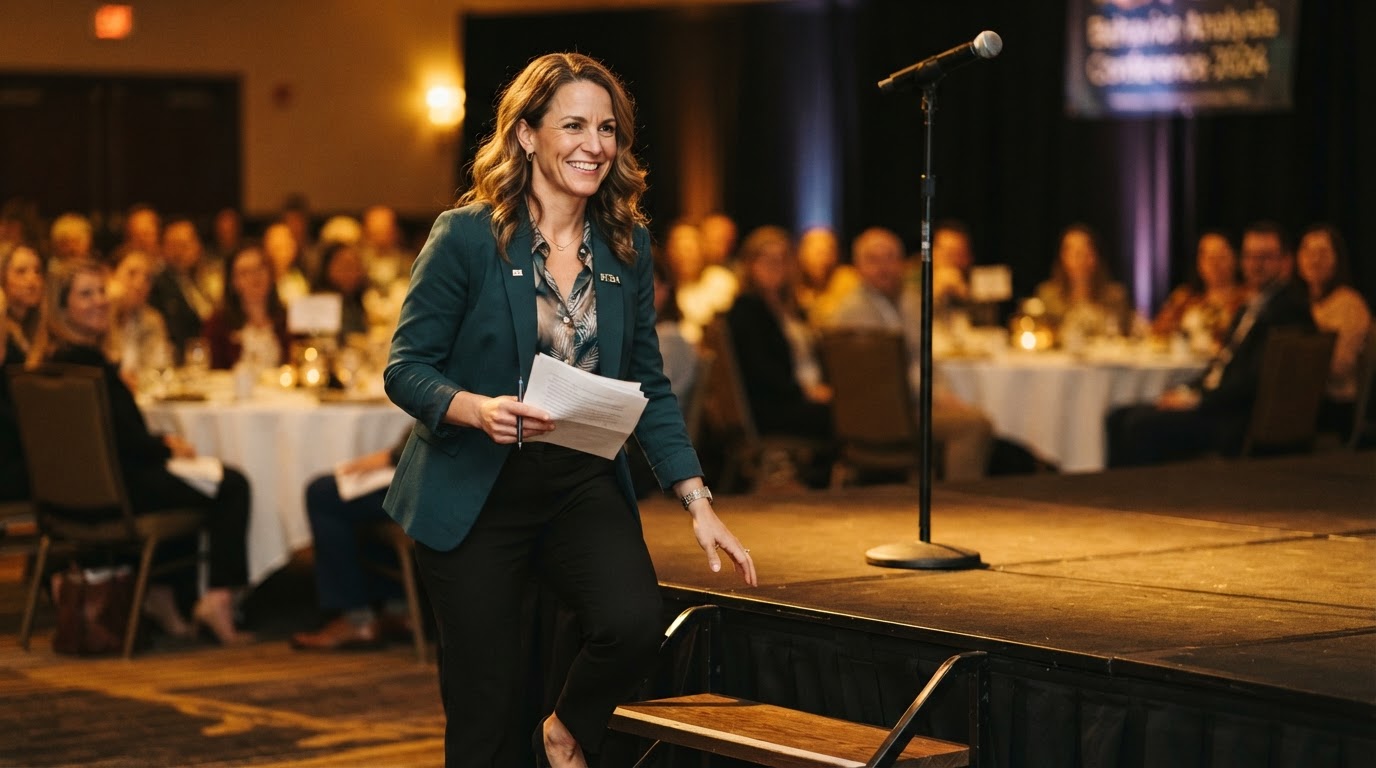
I still have every one of those thoughts in 2026. What's different between then and now is how I respond to them, and that's what I taught when I presented this material at WIBA earlier this month.
"Fear of being seen is avoidance maintained by rules you learned. You can notice the rule, name the value underneath, and take one small visible action while the fear is still there."
Self-Limiting Beliefs Are Verbal Behavior
I tried for a long time to define a self-limiting belief without making it mentalistic. Here's where I landed. A self-limiting belief is a class of verbal behavior like "I'm not ready," "I'll be judged," or "what if this happens," that's part of a broader response class of avoidance and withdrawal.
Those statements seem to describe your reality, and they also function as discriminative stimuli and motivating operations that make avoidance more likely. So instead of treating them as personality traits, look at what they do. When the rule shows up, what are you doing more of or less of? You're doing anything but speaking up in the meeting, applying for the job, setting the boundary, or posting about your offer.
This is the same pattern that keeps BCBAs from marketing their coaching, and it sits right next to the imposter feelings that show up when you start something new.
Rules That Outlive Their Usefulness
None of us had to touch a hot stove to believe it was hot, and nobody had to get hit by a car to learn to look both ways. That's rule-governed behavior, which is behavior controlled by verbal descriptions of contingencies rather than direct contact with them. Rules keep us alive. The trouble starts when the environment changes and we keep following a rule that no longer fits.
Women get handed a lot of these rules. Don't be too much. Avoid conflict. Assertive women are bossy. Since my son was born, nobody has once asked my husband if he's a working dad, and I get asked if I'm a working mom all the time. These generalized rules follow us across settings even when they've stopped serving us.
Picture a woman whose supervisors encourage her to speak up and take on leadership, and who gets positive feedback every time she does. If direct contingencies alone changed behavior, she'd be leading every meeting. Instead she apologizes before sharing ideas and turns down a promotion because being seen feels unfeminine or like too much. The rule is stronger than her direct experience.
Our own field shows the pattern too. In 2015, about 82% of BCBAs were women, according to data from Nosik and Grow cited in this behavior-analytic account of sexism. Yet Li, Curiel, Pritchard, and Poling (2018) found women were substantially underrepresented as authors and editors in behavior-analytic journals. I don't know every reason behind that gap, and I don't like the data.
Your Mind Can Relate Anything to Anything
I was bored out of my mind learning about reflexivity, symmetry, and transitivity in grad school, and then about two years ago I did a deep dive into relational frame theory and it clicked. If I tell you I'm taller than Kendra, you know Kendra is shorter than me without anyone teaching you that. That's a derived relation.
Try this one. How are cats and ice cream similar? You've probably never thought about that in your life, and you can still come up with an answer in seconds. Your mind can relate anything to anything, including your worth.
Here's how that plays out for me. A good friend of mine has close to 20,000 followers on TikTok and I had about 2,000. More is better, less is worse, she has more, so I'm worse. Nobody ever told me I was worse than her. My brain derived it all on its own.
Then there's transformation of stimulus function. I love hiking, and if my husband planned a hike on a trail known for frogs, which terrify me, that trail would go from appetitive to aversive instantly. In 2023, a conference rejected my workshop proposal on intuitive eating and body image. It took me an entire year to submit a proposal anywhere else, because one "no" changed the function of the whole conference platform for me.
This also explains why a compliment from your best friend bounces right off. If "you're a great speaker" isn't coherent with your relational network, the rule wins over the direct experience.
There's no delete button for these relations, and you can learn to relate to them differently.
Ready to stop hiding?
Learn how to use behavior science to get visible while the fear is still there, alongside other BCBAs working through the same thing.
EXPLORE THE CERTIFICATIONBeing Seen Means Feeling the Hard Stuff Too
Fear is going to come with you. We're human, and if you want to feel love, joy, and excitement, you have to be willing to feel fear, anxiety, and sadness too. You don't get one set without the other. Steven Hayes, one of the founders of ACT, draws a line between pain, which we all experience, and suffering, which grows when we fight to get rid of pain.
I've taught myself to relate to fear as a good thing. When I get scared about something now, I read it as a sign that I'm outside my comfort zone and growing. I used to be a little baby deer at the podium, hunched over with my voice cracking, and my husband would remind me that I had volunteered to speak. I kept doing it because disseminating the science mattered more to me than the anxiety.
The more visible I've become, the more comments I get calling me conceited or saying I'm not a real business owner. They hurt my feelings. I also get messages at least once a week from people telling me their lives changed, and I'm willing to feel the first kind to keep getting the second.
At WIBA this summer I found out I'd sent postcards with a spelling error in them to 1,000 BCBAs in their welcome bags. Years ago that would have kept me in my hotel room. This time I laughed, because spelling errors are on brand for me at this point.
A Values-Based Visibility Exercise
Think of one situation where being seen feels risky. Maybe it's presenting at a conference, making a suggestion in a team meeting, asking for a promotion, or posting your offer online. Then walk through these steps.
-
Name what you care about. What quality do you want to embody when you're seen, like contribution, courage, or integrity? Your values will change over your life, and there's no wrong answer.
-
Notice what shows up inside. Write down the thoughts, images, memories, urges, and body sensations, and what you usually do for quick relief, like not posting or keeping everyone else happy. That short-term relief makes sense, and it's worth asking what it costs you long term.
-
Step back from the story. Write the most painful sentence your mind offers, then add "I notice I'm having the thought that" in front of it. An art therapist at our spring retreat called these safety stories, and I love that. Your mind is trying to protect you, so you can thank it and keep going.
-
Commit to one small visible action. Fill in this sentence with a who, what, and when. "Between now and ___, I'm going to ___ while letting my imposter thoughts be present like radio in the background." Then name the value it serves.
We are not our emotions. I'm Sarah, you're you, and the fear is something you're having. The story that I wasn't a speaker turned out to be a skill I hadn't practiced yet, and my word for 2026 is audacity because I want to keep acting before I feel ready. That same audacity is how I ended up booking a call with Dr. Jill Stoddard to ask her to speak at our first retreat, even though I had imposter feelings about asking the author of Imposter No More. She said yes.
Bring ACT Into Your Work With Other BCBAs
Everything in this post, from relational frames to values to committed action, is part of how we coach inside our health coaching certification. You'll practice these skills on yourself first and then with clients, alongside a group of BCBAs who are working through the same fears about being seen. We're running our sixth and seventh cohorts right now.
If you're ready to use behavior science to help people change their lives, and to stop hiding your own work in the process, learn more about the health coaching certification for BCBAs.
What's one visible thing you could do in the next 24 hours? I'd love to hear from you.
Chat soon! ✨
Sarah
FAQ: Fear of Being Seen and ABA
What is fear of being seen?
Fear of being seen is the urge to avoid visibility, like speaking up, presenting, or posting about your work, because of what you predict others will think. From a behavior-analytic view, thoughts like "they'll talk about me" function as rules that make avoidance more likely, and avoidance is maintained by the quick relief it brings.
How does ABA explain self-limiting beliefs?
A self-limiting belief can be defined as a class of covert or overt verbal behavior, such as "I'm not ready" or "I'll be judged," that belongs to a broader response class of avoidance. These statements function as discriminative stimuli and motivating operations that make avoidance responses more likely. Looking at what you do more or less of when the rule shows up makes the belief observable.
What is rule-governed behavior?
Rule-governed behavior is behavior controlled by verbal descriptions of contingencies rather than direct contact with them. Knowing a stove is hot without touching it is a helpful example. Rules become a problem when the environment changes and a person keeps following a rule that no longer fits, such as "assertive women are bossy."
How does relational frame theory relate to confidence?
Relational frame theory explains how people derive relations between things without being directly taught, including relations about their own worth. A comparison like "she has more followers, so I'm worse" is derived, and it can change how a person behaves. Transformation of stimulus function explains how one rejection can make an entire activity feel aversive.
How can BCBAs become more visible while feeling afraid?
Start by naming the value that visibility would serve, then notice the thoughts and urges that show up. Practice stepping back from the story by saying "I notice I'm having the thought that," and commit to one small, specific visible action with a clear date. The goal is acting while the fear is present, since waiting for it to disappear keeps you stuck.
Are women in behavior analysis underrepresented?
Research suggests they are in some areas. About 82% of BCBAs were women in 2015 according to Nosik and Grow, yet Li, Curiel, Pritchard, and Poling (2018) found women were substantially underrepresented as authors and editors in behavior-analytic journals.

Sarah Burby
Founder of Mind Body Behavior and Clinicians for MORE
More from the Journal

You're Not Weak. You're Burned Out. There's a Difference.
BCBA burnout is not a personal failure. It's what happens when people who genuinely care about helping others get trapped in systems built around bill...

BCBA Career Change: You're Not Starting Over, You're Adding On
BCBAs change careers every day, and most of them are not starting from scratch. They are taking years of behavior science training, clinical observati...
