
5 Skills Grad School Didn't Teach You as a BCBA
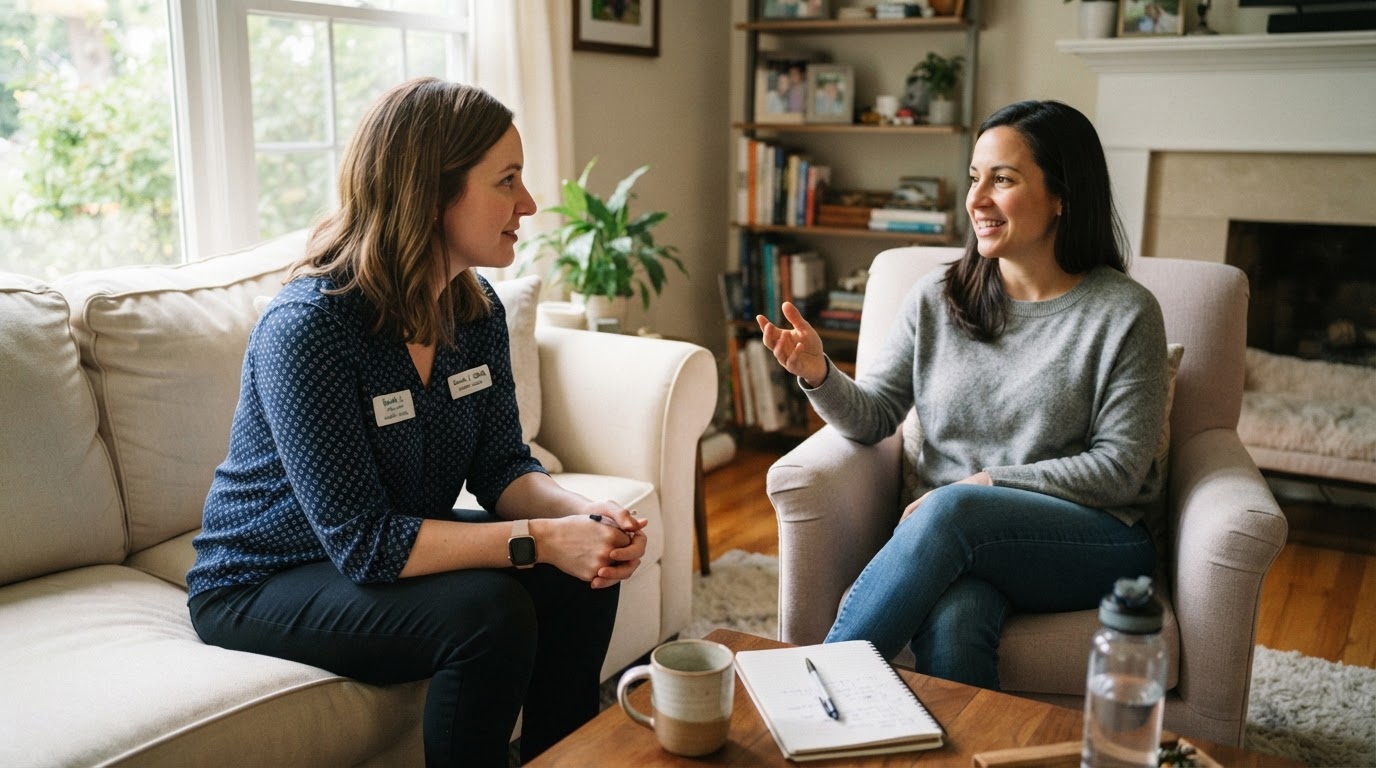
Grad school taught BCBAs the science: assessment, function, treatment planning. It mostly skipped the skills that decide whether any of it gets used: listening, building trust, handling pushback, and collaborating with the people running your plans. Coaching fills that gap, and most BCBAs already have more of it than they think.
I spent eight years as a BCBA before I admitted something out loud that still makes me cringe a little. I used to walk into classrooms thinking I was the expert who had all the answers, and I could not figure out why nobody was following my plans.
I once handed a teacher with thirty kids in her room a five-minute momentary time sample with definitions and a data sheet, and when she told me it was not happening, my brilliant fix was to show up the next day with a kitchen timer so it would remind her. She looked at me like I had lost my mind, and fair enough.
The science was never the problem. I loved the science. What I was missing were the skills nobody handed me in grad school or in supervision, and it turns out there is research showing I was not the only one.
"Grad school taught BCBAs the science. It mostly skipped the skills that decide whether any of it gets used: listening, building trust, handling pushback, and collaborating with the people running your plans."
Why Grad School Skips These Skills (And the Research Proving It)
You were trained to come in, run the FBA, write the plan, and execute. That is what most graduate programs in behavior analysis focus on, the conceptual and technical work, and they leave the relationship side almost untouched.
This is not me being self-critical for fun. Callie Plattner and Cynthia Anderson surveyed 277 BCBAs about these therapeutic relationship skills and concluded that behavior analysts would benefit from explicit training in building and maintaining them, the empathic statements, reflective listening, and affirmations that no one walked us through. So if you feel like you were thrown into rooms with parents and teachers and expected to just know how to connect with them, you were. That is a real gap, and it is documented.
The field is starting to catch up. As of the 2025 6th edition test content changes, the BACB now requires BCBAs to identify and apply interpersonal skills like active listening, accepting feedback, seeking input, and collaborating. The board is finally naming these as required, which is great, and also a little funny if you have been a BCBA for ten years and learned them the hard way through trial and a lot of error.
Here is where coaching comes in. The first entire section of the health and wellness coaching task list, before you touch a single nutrition or movement concept, is on what coaches call being skills. Presence, deep listening, empathy, non-judgment, holding space. The exact things grad school skipped.
You already have the science. What changes is learning to use it with people who feel like partners instead of problems to solve.
Skill 1: Listening to Listen, Not to Respond
When was the last time you asked a parent how they were doing and listened to the answer, instead of nodding while you mentally cued up the data review?
I was terrible at this. I would walk in, say "Hey, how are you," hear "good," and immediately go "cool, let me see last week's data, I gotta graph this, I gotta do that." I had twenty minutes and a list, and the listening was a formality on the way to my agenda.
Deep listening is hard. It means giving something your full attention when your brain has five hundred tabs open, and it means resisting the urge to plan your response while the other person is still talking. In coaching we treat this as a measurable skill, not a personality trait, which means you can practice it and get better at it on purpose.
The shift is small and it changes the whole relationship. You ask the question, you stop, and you let the answer land before you do anything with it.
Skill 2: Showing Up as a Partner Instead of the Expert
The single biggest thing coaching gave me was permission to not have all the answers.
In coaching there is a line I have written on my wall: we are the experts in the process, and the client is the expert in their own life. The first time I heard that, it was a genuine relief, because as a consulting BCBA I felt like everyone looked at me to solve every problem on the spot, and I do not know everything. Nobody does. The whole spirit of motivational interviewing rests on this same idea, that you draw the answers out of the person rather than installing them.
So when a teacher tells you "that's not happening," that is not the end of the conversation, it is the start of a better one. Instead of defending my perfect plan, I learned to get curious: thank you for telling me, I appreciate it, so what do you think could work in here, what have you tried with another student that helped? I had to let my ego down a little and ask what was doable for one human being in a room of thirty.
Was the plan they could realistically run always the most clinically elegant thing I would have designed? No. But a good-enough plan a teacher will use beats a perfect plan getting deleted the second I leave the building, every single time.
Skill 3: Running an Assessment That Includes the Family's Real Priorities
Every assessment is two assessments at once. There is the one your funding source requires, the function, the skill deficits, the medical necessity, the measurements insurance and the IEP need. And then there is the one the family cares about: how do we get through bath time without a meltdown, how do I get my kid dressed and out the door in the morning.
Both lists matter. The mistake I made for years was only running the first one. I would show up with my binder and my tabs and my bin of materials and start pulling things out without ever asking the family where I should sit, what time of day was best, what materials and reinforcers were okay in their home. Kendra shared, "One time I was labeling objects out of a Halloween book with a kid whose family did not celebrate Halloween, which I would have known if I had asked a single question first."
Here is the move that turns this around. You explain your required must-haves in plain language, you ask the family what their priorities are, and then you rank them together. The family's rankings become your treatment priorities, and you build your required pieces into that structure instead of on top of it. You are still meeting every requirement. You are just doing it in an order that means the family will show up for the work.
Skill 4: Using OARS to Handle Hard Conversations
When someone tells you "I already tried that, it doesn't work," you have a choice. You can insist they just need to be more consistent, which is what I was taught and what nobody on earth wants to hear, or you can get curious.
OARS stands for open-ended questions, affirmations, reflections, and summaries, and it is the everyday toolkit of motivational interviewing. It sounds simple written out, and it takes real practice to do well, but it works with parents, teachers, and your own staff.
Open-ended questions invite exploration instead of a yes or no: walk me through what a typical evening looks like at home, or if I could take one thing off your plate right now, what would it be. Affirmations name a real strength you are seeing, the same muscle as behavior-specific praise, just pointed at the adult: you know your child better than anyone in this room. Reflections show people you heard them: so it sounds like you want help, but you don't want to lose the routines your family has already built. Summaries make sure everyone is on the same page before you move forward: let me make sure I've got this right, bedtime and transitions are the big stressors, and you want strategies you can run without another person in the room.
When that parent says they already tried your idea, the OARS version is: oh, you tried that, tell me what happened, what worked and what didn't, and what do you think we could do differently next time. You are not arguing. You are collaborating, and that is the whole difference. For a deeper dive on this, check out our guide to handling difficult conversations as a BCBA.
Skill 5: Supervising the Humans, Not Just the Programs
When an RBT is not running a program the way you wrote it, the reflex is to jump straight to training or teaching. Sometimes that is right. But first it is worth asking the same question we ask about our clients: is this a skill gap, a knowledge gap, or a motivation gap?
A lot of the time the missing piece is the why. I write the assessment, I write the goals, so of course I know why a program is in the plan, but does the RBT understand how this connects to the bigger picture and what the family wants? It is hard to have any ownership over something when you are just going through the motions with no idea why it is there.
The same coaching skills work here. Ask the open-ended questions almost nobody asked us when we were new: how is your caseload feeling right now, is there anything on your plate that doesn't feel sustainable, what part of this client's programming feels solid and where are you still figuring it out. Build the same therapeutic alliance with your team that you build with families, so they feel safe coming to you. I have had RBTs tell me they never wanted to bother me because they knew I was busy, and that one stuck with me, because if I am too busy for my own team, that is something I need to fix, not something they should carry. If you are feeling burnt out as a BCBA, this is often part of why.
Getting Started: How to Build These Skills Without Going Back to School
You do not need another master's degree to start. I looked into getting one in counseling, and my co-instructor went and got one in nutrition, and what we both found is that the skills we were chasing live in coaching, not in another degree.
Start with one question tomorrow. Before you get into the data or the agenda with a parent, teacher, or RBT, ask them what the best thing that happened to them today was. Just notice whether the conversation shifts. This is the one thing I want you to take from this whole piece.
Treat being skills as measurable. Pick one, like deep listening or presence, and practice it on purpose the way you would teach any skill, with a clear definition and a way to know it is improving.
Learn the OARS framework and use it everywhere. It works with caregivers, with teachers, with staff, and in your personal life too. Open questions, affirmations, reflections, summaries.
Find structured practice with feedback. You build coaching by coaching real people and getting real feedback, not by reading about it, which is exactly why our health coaching certification built for BCBAs is six months of live practice rather than videos you watch alone.
Ready to build the skills grad school skipped?
Our NBHWC-approved certification gives you six months of live coaching practice with real feedback, built specifically for BCBAs.
EXPLORE THE CERTIFICATIONReady to Build the Skills Grad School Skipped?
Around 72% of behavior analysts report medium to high burnout at some point, and a huge piece of that is feeling like you are pouring effort into plans nobody runs and conversations that go nowhere. These skills are a real way out of that loop, and you can start using them this week.
If you want to go deeper on how these skills fit into a full career shift, start with the BCBA-to-health-coach path.
Chat soon! ✨
Sarah
FAQ: Coaching Skills for BCBAs
What skills do BCBAs not learn in grad school?
Most graduate programs in behavior analysis focus on conceptual and technical skills and give little attention to relationship skills like deep listening, building rapport, handling pushback, and collaborating with caregivers and staff. A 2023 survey of 277 BCBAs by Plattner and Anderson concluded that behavior analysts would benefit from explicit training in these therapeutic relationship skills.
Why are coaching skills useful for behavior analysts?
Coaching skills fill the exact gap grad school leaves. The first section of the health and wellness coaching task list is dedicated to being skills like presence, empathy, and deep listening, which help BCBAs get genuine buy-in from parents, teachers, and RBTs so that clinically sound plans get used.
What is OARS in motivational interviewing?
OARS stands for open-ended questions, affirmations, reflections, and summaries. It is the core communication toolkit of motivational interviewing, and BCBAs can use it in assessments, IEP meetings, parent sessions, and RBT supervision to handle resistance and build collaboration.
Do BCBAs already use motivational interviewing?
Many BCBAs use elements of motivational interviewing in practice without naming it, since the field overlaps with behavior change work. Learning it explicitly, including the spirit of MI and the four processes of engaging, focusing, evoking, and planning, gives BCBAs a structured way to apply skills they partly already have.
How can a BCBA build these skills without another degree?
You do not need a second master's. These skills live in coaching, and you build them by practicing with real people and getting feedback. Start with small daily practices, like asking one open-ended question before your agenda, and consider an NBHWC-approved coaching certification designed for BCBAs for structured live practice.
Are interpersonal skills now required for BCBA certification?
Yes. As of the 2025 BACB test content changes, BCBAs are required to identify and apply interpersonal skills such as active listening, accepting feedback, seeking input, and collaborating to establish and maintain professional relationships.
Sarah Burby
Founder of Mind Body Behavior and Clinicians for MORE
More from the Journal

You're Not Weak. You're Burned Out. There's a Difference.
BCBA burnout is not a personal failure. It's what happens when people who genuinely care about helping others get trapped in systems built around bill...

BCBA Career Change: You're Not Starting Over, You're Adding On
BCBAs change careers every day, and most of them are not starting from scratch. They are taking years of behavior science training, clinical observati...
